Vertical Candy Depositor Machine

Vertical Candy Depositor Machine Vertical Candy Depositor Machine Vertical Candy Depositor Machine Vertical Candy Depositor Machine Vertical Candy Depositor Machine
1 / 5
Vertical Candy Depositor Machine

Vertical Candy Depositor Machine

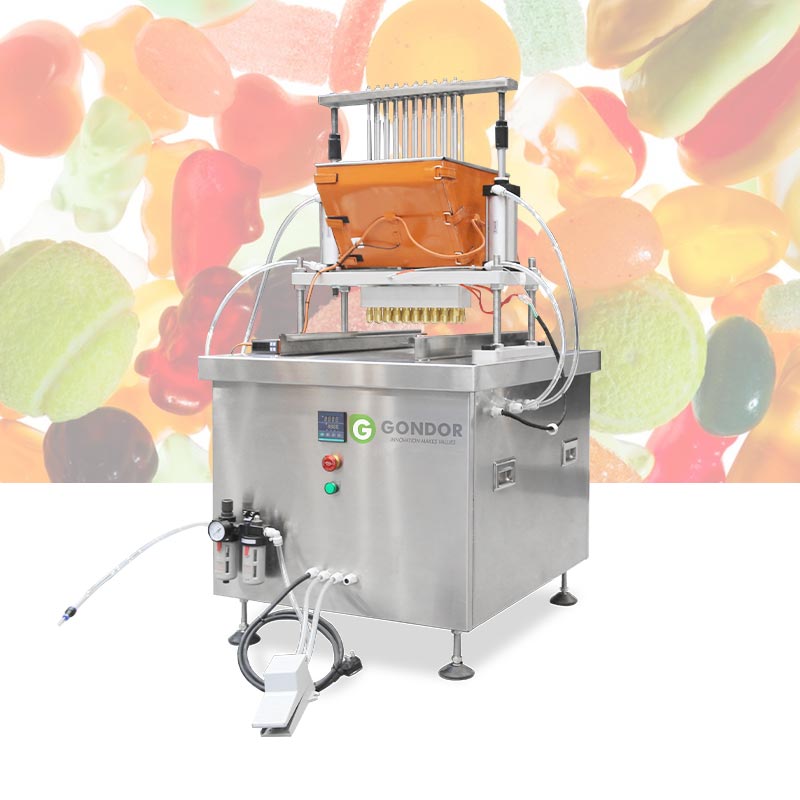
Gondor vertical candy depositor machine delivers precision depositing for gummies, hard candies, and toffees. PLC-controlled, 304 stainless steel, 600-1200 pcs/h. Factory direct with customization.

  • BrandGondor
  • Voltage110V/220V/380V/CUSTOMIZE
  • Power3-6KW
  • Weight280KG
  • Production Capacity600-1200pieces/h

Gondor Vertical Candy Depositor Machine

In a candy production workshop, the daily challenge is often not merely whether a single piece of candy can be produced, but whether every single piece can be made identical—consistent in weight and shape, with no deviation between batches.

For manufacturers of gummies, hard candies, toffees, and nougats, the greatest risk associated with manual pouring or semi-automated operations is a loss of product consistency. An extra two or three grams in a single piece may seem negligible, but when multiplied by a daily output in the millions, the resulting waste of raw materials represents a staggering hidden cost.

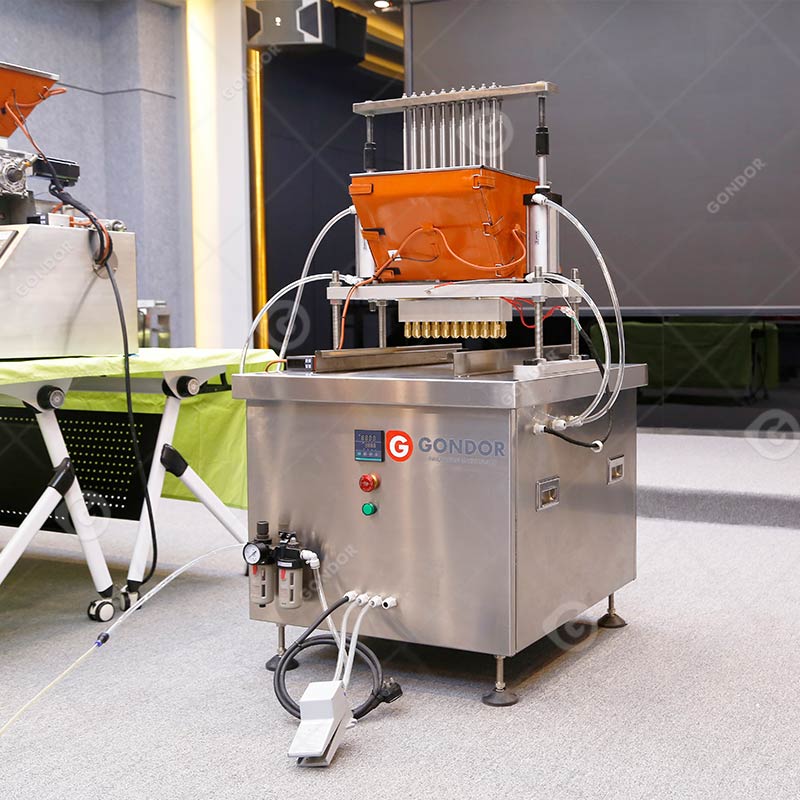
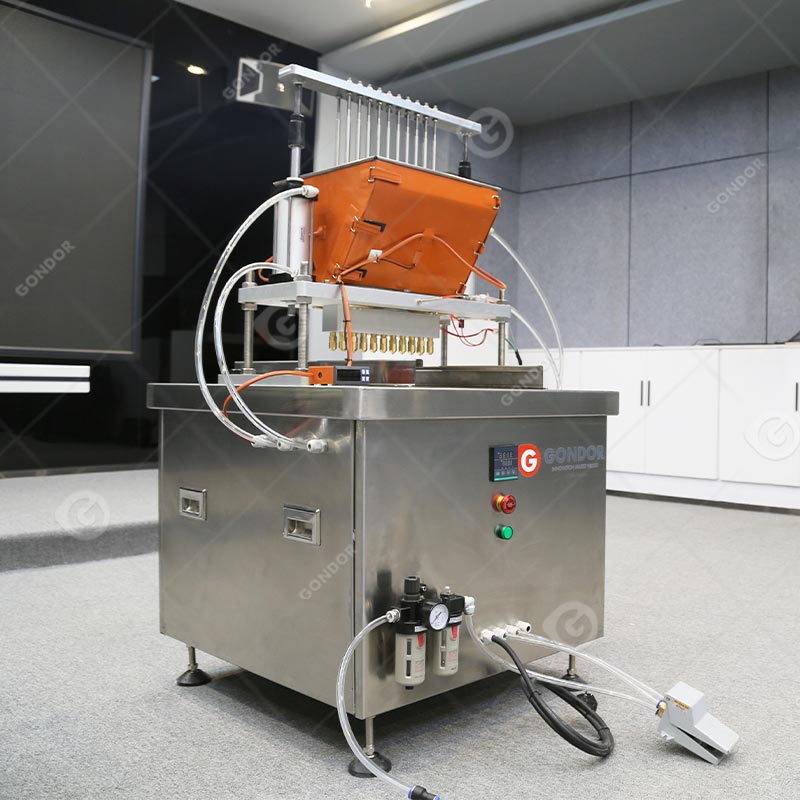
The vertical candy depositor precisely injects syrup from the cooking stage into molds. Utilizing PLC control to ensure an exact dosage for every shot, it maintains candy shape, weight, and quality at a consistent standard. For medium-sized factories producing anywhere from a few hundred kilograms to two tons daily, food companies that have just upgraded to automation, or startups needing to scale up quickly without compromising quality control, this equipment offers a reliable pathway from manual to automated production.

The machine is suitable for a wide range of mainstream products, including gelatin and pectin gummies, hard candies, toffees, and filled candies. Different candy formulations—varying in viscosity, temperature sensitivity, and crystallization tendencies—impose distinct demands on the depositing system; the machine’s adjustable parameter settings are key to meeting these diverse requirements.
Gondor Vertical Candy Depositor Machine
Candy Depositor Machine

Candy Depositor Machine Technical Specifications

Parameter GD-V (Vertical) GD-D (Tabletop)
Depositing Speed 20-35 cycles/min 30-60 cycles/min
Production Capacity 40-150 kg/h 60-100 kg/h
Voltage 220V/50Hz 220V/50Hz
Power 1.2 kW 4.2 kW
Nozzles 20 pcs 10 pcs
Machine Dimensions 804×660×1300 mm 1000×760×870 mm
Weight 320 kg 100 kg
Applicable Candy Types Hard candy, gummies, toffee, nougat, filled candy Small-scale / lab use

Frame Material: 304 food-grade stainless steel Control System: Siemens PLC + touchscreen interface Certifications: ISO 9001, ISO 14001, ISO 45001, CE, BSCI, ETL Mold Options: Silicone molds / Metal molds (both customizable)

Working Principle: Four Stages from Syrup to Finished Candy

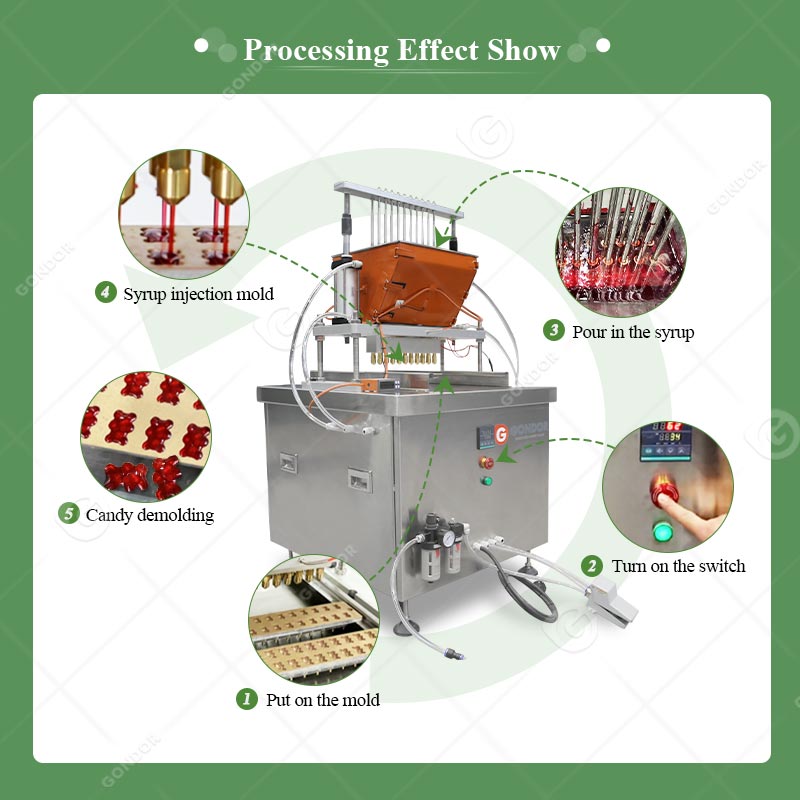
The machine’s operating logic breaks down into four sequential stages, each solving a specific processing challenge.

Step One — Syrup Holding and Temperature Maintenance.
Cooked sugar mass enters the hopper system, which is equipped with temperature control. The set-point range depends on the candy type — gelatin syrup requires 60-70°C to prevent premature setting, while hard candy syrup needs a higher range to maintain flowability. At this stage, temperature control accuracy determines whether the subsequent deposit will proceed smoothly or run into viscosity-related problems.
Step Two — Precision Depositing.
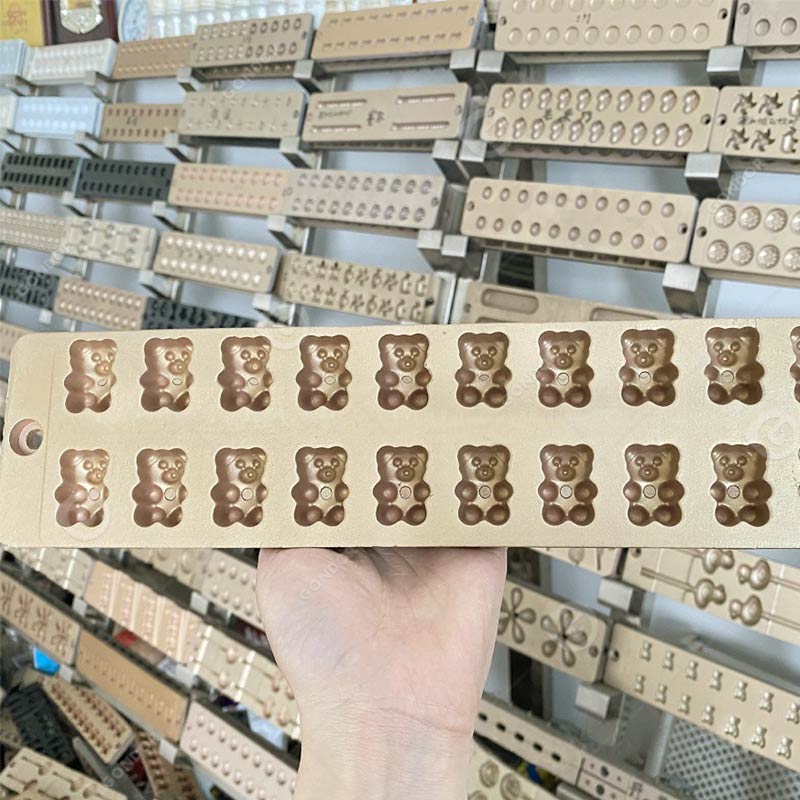
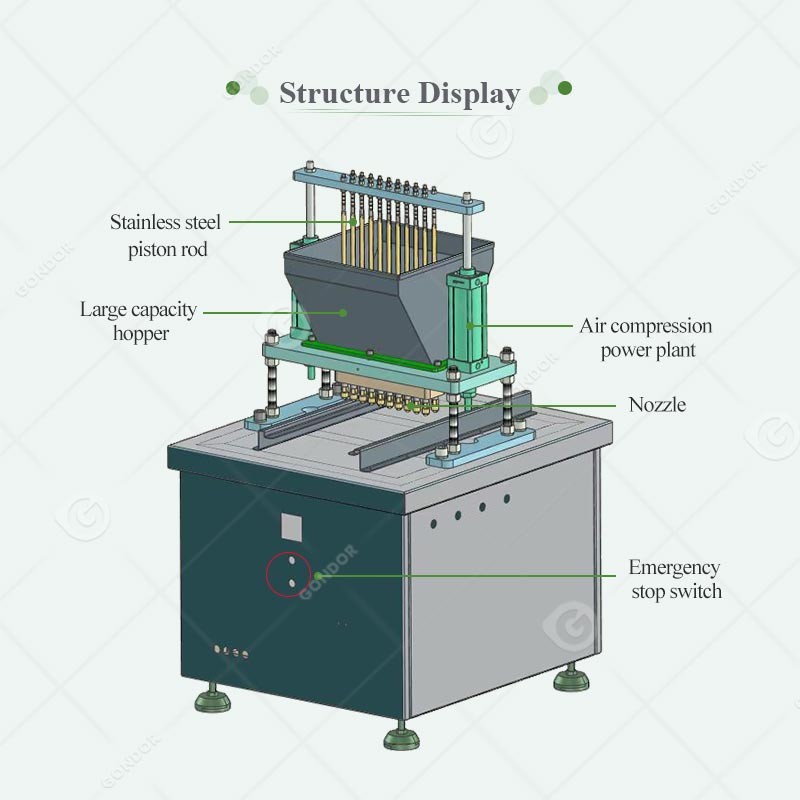
This is where the machine earns its keep. A PLC-controlled piston pump regulates the deposit volume by adjusting stroke length and speed. Different molds call for different fill volumes — a 2-gram gummy bear, a 6-gram lollipop, an 8-gram toffee — and these parameters can be switched via the touchscreen interface without changing any mechanical parts. The nozzle geometry — diameter, angle, and discharge velocity — is designed to prevent splashing, stringing, or air bubble formation at the moment the syrup contacts the mold surface.
Step Three — Cooling and Setting.
Filled molds move into the cooling zone. The cooling profile is customizable: gelatin-based candies benefit from gradual cooling to avoid surface skin formation, while hard candies require rapid cooling to achieve the desired glass-like structure. Molds circulate through a vertical or horizontal conveyor system with adjustable dwell time to match the candy type and output rate.
Step Four — Demolding and Discharge.
Once the candy has fully set, it releases from the mold and proceeds to the packaging line. The empty molds return to the depositing position through an automatic cleaning cycle, forming a continuous production loop.

Throughout the process, sensors monitor temperature, deposit weight, and mold position in real time. Any deviation outside the programmed tolerance triggers an automatic stop or alarm. For the operator, the job shifts from watching each piece of candy to monitoring parameters and rhythm — a fundamentally different role.

Candy Depositing Machine Application Scenarios

Candy Manufacturing Industry
This is the most classic application area. Ranging from large candy conglomerates to boutique workshops, the role of depositing machines is shifting from merely “replacing manual labor” to “achieving precision impossible to attain by hand.” Crystal hard candies, filled toffees, and vitamin gummies—each type of candy has unique requirements regarding depositing temperature, speed, and pressure, necessitating equipment with a wide range of adjustable parameters.
Functional Foods and Health-Oriented Confectionery
One of the fastest-growing categories in recent years. Products such as DHA algal oil gummies, probiotic gummies, and Vitamin C lozenges contain active ingredients that are highly sensitive to temperature and shear forces; the precision of temperature control during the depositing process directly impacts the retention rate of these active ingredients. This is why food technology companies often list “temperature control precision of ±1°C” as a top priority when sourcing depositing machines.
Bakery and Dessert Processing
Many bakery enterprises produce dessert items—such as nougat, chocolate truffles, and caramel-filled treats—rather than just croissants or bread. In these categories, depositing machines do more than simply fill molds with ingredients; they ensure visual consistency across every piece in a batch—a factor of particular importance for branded, packaged bakery desserts.
Chocolate and Coated Products
Chocolate presents specific challenges for the depositing process due to its low melting point and narrow crystallization window. Vertical depositing machines equipped with independently temperature-controlled nozzles maintain the fluidity of the chocolate mass while preventing clumping at the nozzle caused by temperature fluctuations. For manufacturers of filled chocolates and truffles, precise dosing ensures a consistent ratio of filling to shell in every piece.
Central Kitchens and Pre-made Dessert Supply Chains
A common challenge faced by dessert chains and suppliers of pre-made desserts is ensuring that products from different stores or batches look as though they originated from the same factory. When central kitchens mass-produce items like puddings, jellies, and panna cotta, the dosing precision and consistency provided by depositing machines directly resolve this pain point.
Pet Treats and Functional Pet Food
Pet nutritional supplements and functional pet treats are rapidly expanding from the health supplement sector into the mainstream pet food market. For gummy-style pet vitamins and joint-health treats, pouring machines are essential to ensure consistent levels of active ingredients in every piece. While the market is not yet saturated, supplier requirements are clearly defined: a food-grade production environment and precise dosing capabilities serve as the fundamental prerequisites.

Core Value: Four Returns That Matter on the Production Floor

Precision is profit.

A deposit weight tolerance of 0.2-0.5 grams per piece may not sound extraordinary. But on a production line outputting 200 metric tons of gummy candies per year, saving 0.3 grams per piece translates to hundreds of kilograms of raw material saved annually. Not from evaporation or process loss — purely from “overshooting the fill.” The PLC-controlled dosing system on this machine cuts that waste to the minimum achievable level.

Continuous production is a daily reality, not a concept.

Semi-automatic equipment often requires a full stop when switching between batches — different molds, different fill volumes, different temperature profiles. The vertical depositor’s continuous-run design allows operators to swap molds and adjust parameters without interrupting production. For factories running multiple candy SKUs on the same line, this flexibility means less downtime and more effective output. Well-maintained units routinely operate 16-hour shifts.

Food safety is the entry ticket, not a bonus feature.

304 stainless steel is standard in confectionery machinery, but the real differentiator lies in the details — weld seam finishing, surface roughness, elimination of dead zones where product can accumulate. The hopper and piping on this machine are designed with polished welds and detachable connections, making them easy to clean and resistant to bacterial buildup during long production runs.

Floor space is an operating cost.

The vertical layout isn’t about looking tall — it’s about footprint efficiency. For plants with limited floor area, a single unit occupying roughly 0.5 square meters concentrates production capacity in the vertical dimension, reserving valuable ground space for downstream packaging or future line expansion.