

Valerio Sortino, the owner of Kirat Srl, is a confectionery artisan from Sicily, Italy. The company specializes in handcrafted sweets and chocolates, earning a strong local reputation for its traditional production methods and exceptional taste.
For years, Kirat relied entirely on manual labor for mixing, molding, and packaging its products; while this ensured high quality, it also limited production volume and product variety.
In mid-2025, Valerio approached Gondor Machinery with a clear strategic goal: to expand the product line to include lollipops without the need to build a large-scale industrial plant. His vision was to introduce semi-automated processes candy depositor machine—capable of small-batch depositing, molding, and basic packaging—while preserving the brand’s artisanal spirit.
Key constraints for the project included the requirement that the new equipment fit within the existing workshop layout, operate with low energy consumption, and be user-friendly enough to run without advanced technical expertise.
This project reflects a common need among many small European food producers: the transition from total reliance on manual labor to moderate mechanization, allowing for improved product consistency and output while maintaining the brand’s unique flexibility and character.
Customer requirements for lollipop production
Valerio’s inquiry outlined a tightly defined scope of needs that reflected both his ambition and his operational reality:
6,200USD circulating in his research, Valeriowas operatingina sub-10,000 equipment budget band. He needed transparent pricing on the machine itself plus all ancillary costs — molds, shipping, import duties, and commissioning support — before he could present the investment to his business partners.
Customer Concerns During Communication
Several key challenges emerged during the four-round follow-up process. These were not criticisms directed at the buyer, but rather typical obstacles encountered by small-scale confectionery manufacturers when importing their first piece of processing equipment from Asia.
Uncertainty regarding equipment-product compatibility—The core issue was whether a tabletop depositor designed for standard molding operations could reliably produce lollipops with sticks. Valerio repeatedly asked, “Do you provide the molds?”
This reflected deeper concerns: he was unsure if the machine supported custom lollipop molds and stick-insertion functions, or if the depositor nozzle design was suitable for viscous syrup at his planned small-batch production scale. Without physical samples or local reference cases, he could not personally verify these performance specifications.
Lack of familiarity with import logistics—This was Kirat’s first time directly importing industrial equipment. Valerio was concerned about the “total landed cost,” which included sea freight to Sicily, Italian customs clearance fees, VAT, and potential inland transport costs from the port to the factory.
It was precisely this lack of an experienced cross-border machinery procurement team that drove his request for a detailed cost breakdown.
Uncertainty regarding workshop integration—Since his existing facility was laid out for manual workstations rather than a production line, Valerio was concerned about utility connections (water and electricity), ventilation, and hygiene standards. He had not yet created a formal factory layout plan, so he could not determine the machine’s installation location without first fully understanding its footprint and power requirements.
Lack of prior relationship with the supplier—For a first-time buyer, confidence in after-sales support is a critical factor. Valerio had no reference point for how Gondor Machinery would handle technical inquiries, spare parts requests, or remote video troubleshooting once the machine was installed in Sicily—8,000 kilometers away.
Our Technical Recommendation
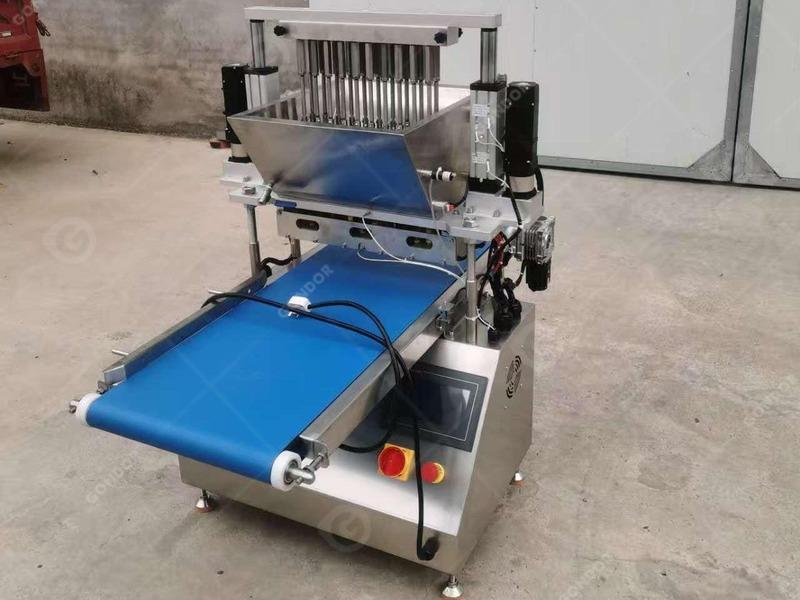
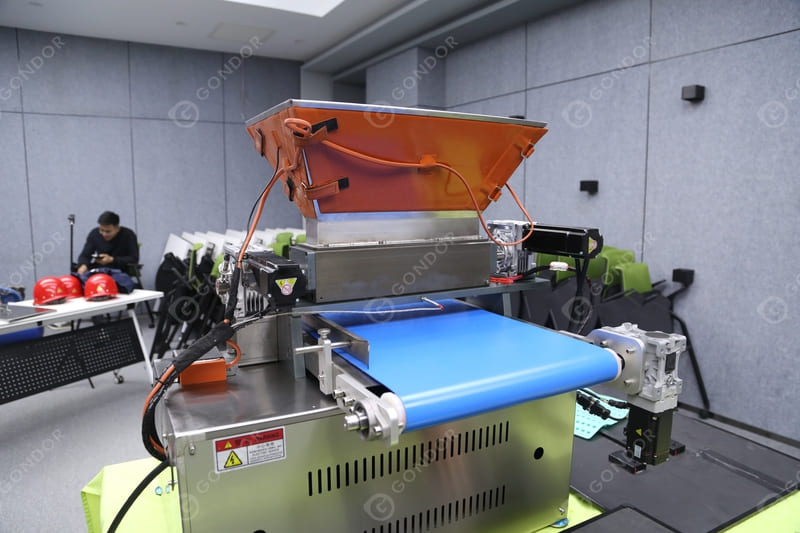
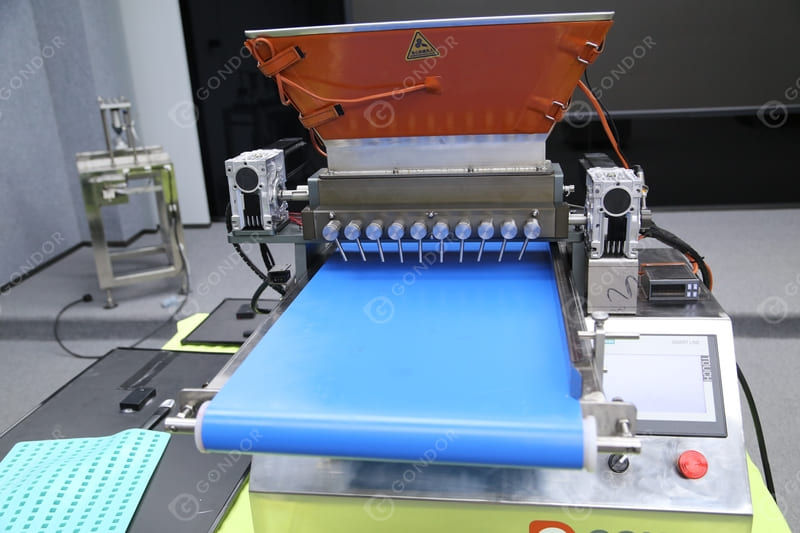
Based on Valerio’s requirements, Gondor Machinery recommends a tabletop confectionery depositor—a compact, stainless-steel unit designed specifically for small-batch candy workshops. The following outlines the rationale for this recommendation, considering the transition from artisanal production to a semi-automated process.
Why choose this model? This tabletop depositor combines cost-effectiveness, a modular design, and food-grade manufacturing standards. Unlike large-scale continuous depositing lines that require over 50 square meters of floor space and three-phase industrial power, this unit fits directly onto a standard commercial workbench.
It operates on single-phase power, connecting easily to a standard 230V outlet; weighing less than 150 kg, it can be moved without specialized lifting equipment.
Why not choose a full lollipop production line?
A complete automatic lollipop production line (comprising batch cookers, vacuum cookers, depositors, stick inserters, cooling tunnels, and packaging machines) costs well over $50,000 and requires a dedicated facility with climate control systems.
For Kirat’s current production volume and budget, this represents an excessive investment with an overly long payback period. The tabletop depositor offers a low-risk entry point: Valerio can first validate the lollipop product in the market. If demand grows, he can upgrade to a continuous production system later while retaining the tabletop unit for R&D or small-batch seasonal production.
Mold flexibility—the depositor accommodates custom silicone or metal molds, provided the mold frames meet the machine’s clamping dimensions. This is crucial for lollipop production. Gondor’s engineering team can evaluate mold design files (CAD drawings or hand-drawn sketches) and provide advice on cavity count, wall thickness, and draft angles.
The stick insertion process is typically handled by a manual or semi-automatic stick inserter installed in tandem with the depositor; this unit can be added as an optional module without the need to purchase an entire production line.
Recipe Compatibility—The depositor is designed to handle syrup in the 120–150°C range, meeting the formulation requirements for traditional hard candies and lollipops. As Kirat already produces artisanal confectionery, their existing batch cookers can continue to be used for the initial processing stages; the depositor replaces only the manual depositing step. This approach preserves existing capital equipment while reducing overall integration costs.
Future Upgrade Path—Should Kirat require higher production capacity in the future, the tabletop depositor can be supplemented with a compact cooling tunnel (3–5 meters) and a flow-wrapping machine. The control panel of the existing unit is already equipped to send trigger signals to downstream conveyors, meaning the original equipment does not need to be discarded when upgrading to a small-scale integrated production line.
Candy Depositor Machine Equipment Solution
The following specifications reflect the Tabletop Candy Depositor Machine recommended for this project. Where exact parameters were not discussed in the correspondence, standard configurations for this machine class are provided to give a complete technical picture.
| Parameter | Specification |
|---|---|
| Machine Name | Tabletop Candy Depositor Machine |
| Capacité | 10–30 kg per batch (dependent on mold cavity count and recipe viscosity) |
| Pouvoir | 1.5 kW, 220–240V / 50–60 Hz, single-phase |
| Material | Food-grade 304 stainless steel contact surfaces; anodized aluminum frame |
| Depositing Mechanism | Piston-type volumetric depositing with adjustable shot volume |
| Heating System | Electric jacketed hopper with PID temperature control (±2°C accuracy) |
| Automation Level | Semi-automatic — operator loads molds, presses start pedal, removes filled molds |
| Mold Compatibility | Custom silicone or metal molds; clamping frame adaptable to customer drawings |
| Optional Configuration | Stick insertion module, rotary mold table, mini cooling tunnel (1.5 m), flow-wrapper interface |
| Suitable Products | Hard candies, lollipops, gummy candies, jelly candies, fondant centers, chocolate shells |
| Footprint (L × W × H) | Approx. 850 mm × 600 mm × 1,200 mm |
| Poids | 120–140 kg |
| Certification Basis | Manufactured to CE-compatible mechanical and electrical standards; food-contact surfaces compliant with EU 1935/2004 |
| Quoted Price (FOB) | 3,600–4,000 USD (subject to final configuration and mold design) |
Why This Solution Fits the Client’s Needs
From both technical and commercial perspectives, provided the challenges regarding molds and sticks are resolved, the recommended tabletop depositor is an excellent match for Kirat’s business model. Here is a detailed analysis of this suitability:
Gondor Candy Depositor Machine FAQs
How do I choose the right capacity for a candy depositor?
You should base your choice on your current single-batch output and daily production targets, rather than on five-year projections. For artisanal workshops with a daily output of 10–50 kg, a tabletop batch depositor is usually sufficient. Once your daily output exceeds 200 kg and your product range (SKUs) stabilizes, you can upgrade to a continuous production line.
Can the machine be customized for my specific candy shapes?
Yes. Provided you supply CAD files, detailed sketches, or physical samples, we can adjust the mold frame and nozzle layout to accommodate custom molds. The supplier will evaluate factors such as cavity count, wall thickness, and draft angles to ensure smooth demolding and accurate dosing.
What certifications apply to food-contact machinery?
Equipment manufactured by Gondor Machinery features food-contact surfaces made of 304 stainless steel, with mechanical and electrical designs that comply with CE standards. For exports to the EU, buyers are typically responsible for local CE conformity assessments and declaring compliance with EU Regulation No. 1935/2004 regarding materials in contact with food. The electrical control cabinet supports operation on a 220–240V / 50Hz single-phase power supply.
What is the production lead time?
Once the mold design is confirmed and the deposit is received, the manufacturing lead time for a standard tabletop depositor is typically 20–25 working days. Custom molds may add 10–15 working days to the production time, depending on complexity. Sea freight from China to Italy usually takes 25–35 days; delivery to Sicily requires an additional 5–7 days after customs clearance.