

Candy Depositor Procurement Project Overview
In mid-2026, Bangladesh-based confectionery manufacturer ANA Foods, led by owner Mr. Shah Alam, partnered with Gondor to upgrade its lollipop production line from a manual silicone-mold workflow to a semi-automatic depositing system. The customer had been running approximately 7,000 lollipops per day with 4–5 production, and needed a path to scale capacity without abandoning the custom mold shapes — round, heart, star, emoji, and workers flower — that his local customers recognized him by.
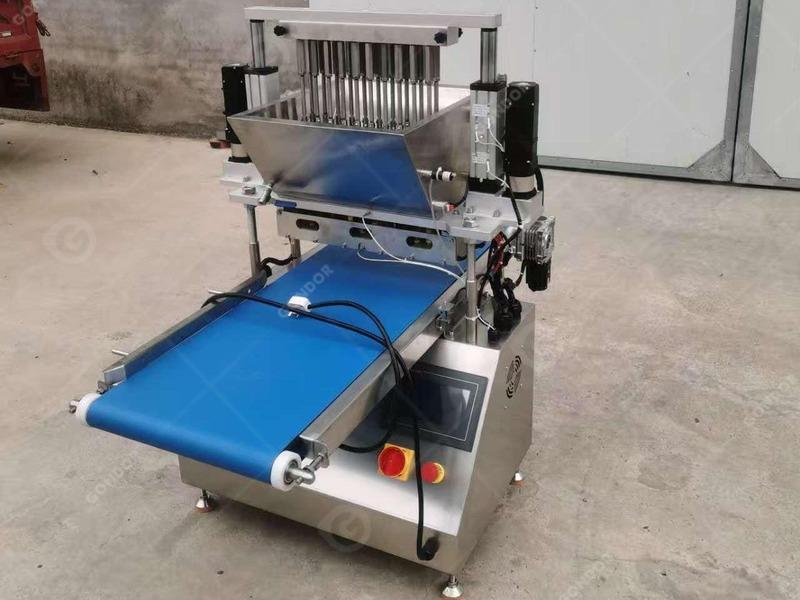
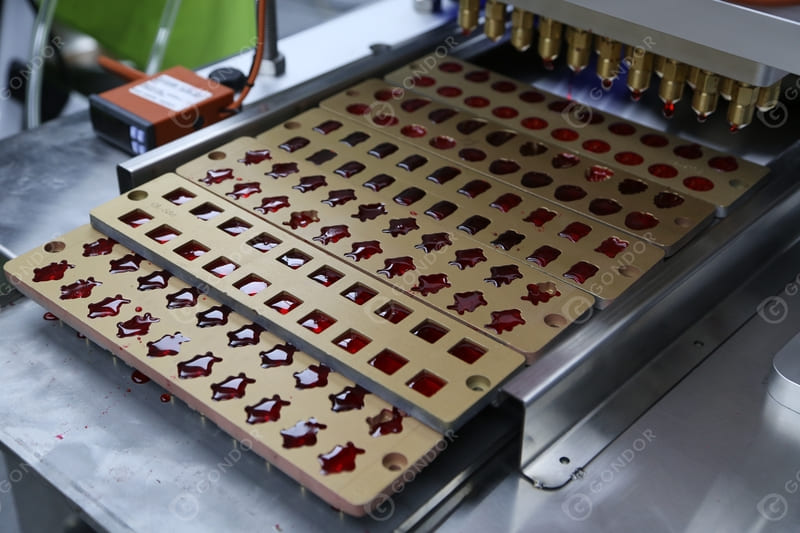
After a structured technical consultation led by Gondor project manager Lilith, ANA Foods selected the Gondor GD Tabletop Candy Depositor (10-nozzle configuration). The machine was shipped, installed, and commissioned in the customer’s Dhaka workshop, where it now runs daily shifts across lollipop, jelly candy, and hard candy products on a single frame.
Customer Requirements
From the initial inquiry on June 19, 2026 and subsequent WhatsApp conversations, Mr. Shah Alam outlined a clear set of requirements for his next equipment investment.
| Item | Requirement | Customer’s Stated Need |
|---|---|---|
| 1 | Product type | Hard candy, jelly candy, lollipop — all three on one platform |
| 2 | Daily output | Must exceed current 7,000 pcs/day silicone-mold capacity |
| 3 | Labor footprint | Reduce the 4–5 headcount required for manual demolding |
| 4 | Mold compatibility | Must accept his existing silicone round, heart, star, emoji, and flower lollipop molds |
| 5 | Future flexibility | Add cartoon-character molds, bear molds for jelly candy, and new lollipop shapes (round, flat, square) |
| 6 | Automation path | Start with semi-automatic today; graduate to fully-automatic candy lollipop making line as market grows |
| 7 | Heating preference | Steam, electric, or gas — customer left open for engineering recommendation |
The combination of “use my existing molds + add new shapes later + semi-auto first” defined the engineering challenge: the chosen depositor had to be modular in nozzle layout and mold-agnostic in cavity spacing.
Challenges Identified
Three distinct challenges shaped how Gondor positioned the technical recommendation.
Technical Recommendation
Based on the requirements and challenges, Lilith recommended the Gondor GD Tabletop Candy Depositor (10-nozzle configuration) — a compact machine engineered for small-to-medium confectionery workshops transitioning from manual to semi-automatic production.
Why This Machine Fits
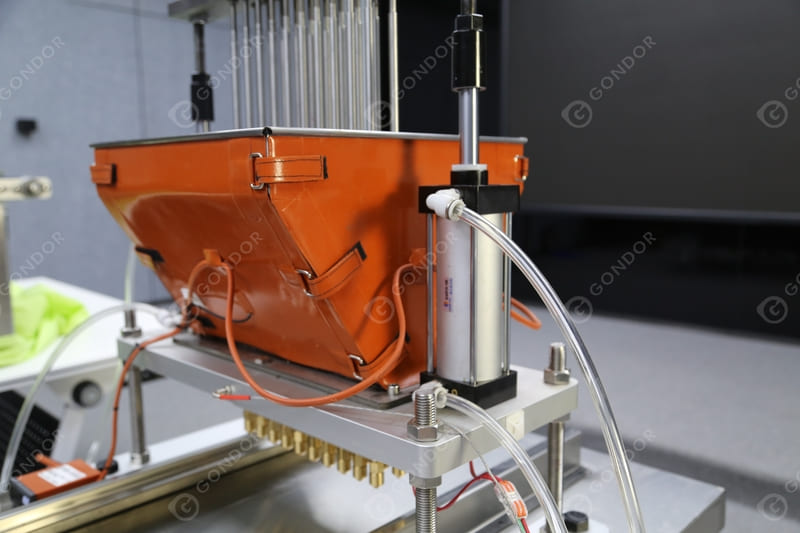
Independent Nozzle Control. Each of the 10 nozzles can be opened or closed individually with 360° rotation, allowing the buyer to align nozzle pitch with any mold’s cavity arrangement — including his existing silicone molds.
Mold-Agnostic Depositing. The customer can use a 6-cavity round lollipop mold today and an 8-cavity bear mold tomorrow — all on the same frame, simply by closing unused nozzles.
Stick-Slot Compatible. For lollipop applications, a dedicated stick-insertion slot can be reserved on one side of the cavity during custom mold design — the depositor head’s gentle pouring action accommodates this geometry without modification.
Three-Product Capable. With adjustable electric heating (up to 240°C), the machine handles hard candy, jelly candy, and lollipop syrup in separate runs with simple cleaning between batches.
Capacity Step-Up. The 10-nozzle head deposits up to 30 cycles per minute, yielding approximately 18,000 candies per hour — comfortably above the customer’s previous 7,000 pcs/day baseline.
Equipment Specification Table — Gondor GD Tabletop Candy Depositor
Equipment Specification Table — Gondor GD Tabletop Candy Depositor
| Specification | Value |
|---|---|
| Modèle | Gondor GD Tabletop Candy Depositor |
| Material (contact parts) | SUS304 Stainless Steel |
| Number of depositing nozzles | 10 (independently adjustable, 360° rotation) |
| Pouring cycles | 15–20 cycles/minute (standard) · 30 cycles/minute (peak) |
| Maximum output | ~18,000 pcs/hour (configuration-dependent) |
| Tension | 220V / 50Hz single phase |
| Pouvoir | 4.2 kW (servo motor × 3) |
| PLC control | Siemens |
| Hopper capacity | 16 L |
| Minimum pouring amount | 0.2 g |
| Maximum temperature | Normal temperature – 240°C |
| Heating method | Electric (steam / gas optional) |
| Construction | Food-grade 304 stainless steel, hygienic design |
| Operation | User-friendly touch-screen HMI |
| Mold change | Quick-release, no-tools-required swap |
| Footprint | Compact tabletop design — small workshop friendly |
| Suitable for | Product development R&D and commercial small-batch production |
Communication Highlights
A structured WhatsApp thread captured the technical discovery loop that led to the purchase decision. Below are the moments that shaped the buyer’s evaluation.
Highlight 1 — The “What Are You Making?”
Question. Lilith’s first qualifying question was direct: “May I ask which type of candy are you planning to produce?” Mr. Shah Alam answered: “Hard Candy, Jelly candy and lollipop.” This confirmed that a single-frame, multi-product depositor was the right category, not a single-application gummy line.
Highlight 2 — Sharing Real Production Footage.
Lilith sent demonstration videos of the machine depositing into silicone molds. The buyer responded with photos of his own lollipop molds (round, heart, star, emoji, flower, bear). The consultation shifted from generic specification talk to concrete engineering evaluation — both sides could now see the same physical artifact.
Highlight 3 — Addressing the Lollipop Stick Concern.
Lilith proactively explained: “If you plan to produce lollipops, we will reserve a slot on one side of the mold for inserting the stick.” This addressed the customer’s anxiety about whether a generic candy depositor could actually produce lollipops — a recurring hesitation in Bangladesh inquiries where most tabletop units are positioned as gummy machines.
Highlight 4 — Capacity Comparison Made Concrete.
When the buyer revealed his 7,000 pcs/day baseline, Lilith translated the 10-nozzle / 30-cycle spec into a business outcome: “It can produce up to approximately 18,000 candies per hour.” This shifted the conversation from “is the machine good?” to “how does it multiply my output?”
Highlight 5 — The Mold-Compatibility Close.
After reviewing the customer’s mold photos, Lilith confirmed: “Your existing molds should be fully compatible with our depositing system.” This removed the largest single objection (mold replacement cost) and reframed the buyer’s legacy silicone mold inventory from a sunk cost into a continuing asset — a decisive factor in the decision to proceed with Gondor.
Solution Delivery & Installation
Following order confirmation, the GD Tabletop Candy Depositor was shipped to ANA Foods’ facility in Bangladesh with export-grade packaging, an English operation manual, recommended depositing parameters for each product type, and a spare-parts kit. Installation was completed in a single working day — the customer’s existing 220V single-phase workshop power required no electrical upgrade.
Gondor’s remote commissioning support, conducted via video call, walked Mr. Shah Alam and his lead operator through hopper loading, syrup temperature calibration, nozzle-to-cavity alignment using his existing molds, stick-slot positioning for lollipops, cleaning and changeover between product runs, and daily maintenance. By the end of the second day, the operator was running commercial lollipop production independently.
Results & Impact
After the first month of commercial operation, the impact on ANA Foods’ production economics was measurable across four dimensions.
Output Expansion. Daily lollipop output rose from 7,000 pcs/day (manual) to approximately 50,000 pcs/day (semi-automatic, single shift) — a roughly 7x increase, with the depositor running at 18–20 cycles per minute in standard production.
Labor Reallocation. The manual workflow required 4–5 workers for hand-demolding. With the GD in place, the same daily volume is now produced by 2 operators, with redeployed staff shifted to packaging and distribution to absorb the increased output.
Mold Asset Preservation. The customer’s full library of silicone molds — round, heart, star, emoji, flower, bear — remained in commercial use. No mold inventory was discarded; changeover between mold formats is completed in under five minutes.
Product Portfolio Broadening. Within the first month, ANA Foods introduced two new lollipop shapes (flat round and square) using custom molds designed with Gondor’s stick-slot specification, and began short-run jelly candy production on the same frame.
Customer Feedback
Mr. Shah Alam summarized the outcome in a follow-up message:
“The machine is working well. We can now produce much more than before with fewer people. The mold compatibility was the key for us — we didn’t have to throw away our existing shapes, and our customers still recognize our products. We are already planning to add a fully-automatic line as the next step.”
Why This Solution Matches
The Gondor GD Tabletop Candy Depositor is not a universal best-fit for every confectionery buyer — but for a Bangladesh small-batch manufacturer with the profile of ANA Foods, four alignment factors made it the technically and commercially appropriate choice.
Capital Efficiency. At RMB 26,000 (≈ USD 3,600) versus a competing supplier’s USD 5,500 quote, the depositor sat below the competitor’s price by roughly USD 1,900 — changing the payback period from quarters to months. The customer recovered the equipment cost within the first quarter of commercial operation.
Workshop Footprint. Bangladesh small confectionery workshops typically operate in 30–80 m² spaces with single-phase power. The GD’s compact tabletop design, 220V single-phase voltage, and 4.2 kW power draw fit this profile without electrical upgrades — a practical requirement that ruled out several larger competitors.
Mold Asset Preservation. The buyer’s silicone mold library represented product identity in his local market. Customers recognized his lollipops by shape (heart, emoji, star). The GD’s independent nozzle control preserved this asset and protected the brand recognition the customer had spent years building.
Graduated Automation Path. The customer stated during consultation: “Slowly but steadily we will add line machine from semi automatic machine in future.” The GD was positioned as the entry point of this roadmap — compatible with future Gondor fully-automatic lines so the buyer can upgrade without replacing his entire platform. Post-installation, the customer confirmed plans to proceed to the next automation stage.
Industry Insights
This project reflects several broader patterns in the South Asian small-batch confectionery equipment market in 2026.
Insight 1 — The Bangladesh Lollipop Market Is Manual-Heavy
Most small confectionery workshops in Bangladesh still rely on silicone mold + hand-demolding workflows. Output is constrained by labor, not by recipe or demand. Equipment that delivers a 5–7x output increase at sub-USD 5,000 price points is adoption-ready, with payback periods of one to two quarters typical.
Insight 2 — “Can It Make Lollipops?” Is the Real Question
Tabletop candy depositors are often marketed as gummy or hard candy machines. Buyers in lollipop-dominant markets frequently assume these machines cannot do lollipops. Engineering teams that proactively address stick-insertion geometry in the first message dramatically shorten the evaluation cycle — as this project demonstrated.
Insight 3 — Mold Compatibility Is a Hidden Line Item
A buyer with five mold formats has USD 1,000–3,000 sunk into his mold library. Equipment vendors who position their machines as “mold agnostic” by allowing independent nozzle on/off preserve this asset and win on total cost of ownership — even at a slightly higher unit price.
Insight 4 — The Semi-to-Fully Automatic Pathway
Buyers in developing confectionery markets rarely buy a fully-automatic line outright. They start with a tabletop depositor, prove the product-market fit, and then graduate. Vendors who explicitly design the tabletop unit as the entry point of a future fully-automatic line capture the long-term customer relationship — as ANA Foods’ confirmed plan to upgrade demonstrates.
Conclusion
The ANA Foods project demonstrates how a tabletop candy depositor, correctly specified and professionally commissioned, can transform a Bangladesh manual lollipop workshop into a semi-automatic producer within a single quarter. The buyer — previously constrained at 7,000 pcs/day with 4–5 workers — now runs approximately 50,000 pcs/day with 2 operators, on a single frame that handles lollipops, jelly candy, and hard candy interchangeably.
The success of this project rested on four engineering decisions: preserving the customer’s existing mold library, proactively addressing lollipop stick-insertion geometry, sizing the machine for a realistic single-shift capacity step-up, and positioning the tabletop unit as the on-ramp to a future fully-automatic line. For B2B confectionery equipment vendors evaluating similar South Asia inquiries, the lesson is consistent: ask about the buyer’s existing mold library first, address stick-insertion geometry proactively, translate cycle speed into business outcomes, and design every tabletop unit as the first step in a long-term automation roadmap.
Frequently Asked Questions
Q1: What is a tabletop candy depositor and how does it differ from a full-size candy production line? A tabletop candy depositor is a compact, semi-automatic machine — typically 0.5–1.5 m² footprint — designed to pour heated candy syrup into pre-positioned molds. Unlike a full-size candy production line (which integrates cooking, depositing, cooling tunnel, demolding, and packaging in a continuous flow), a tabletop unit handles only the depositing stage and is intended for small-batch production, R&D, and workshops with limited space.
Q2: Can a single tabletop candy depositor produce both lollipops and gummy candies? Yes. Modern multi-nozzle tabletop depositors like the Gondor GD handle hard candy, jelly candy, and lollipops on the same frame. The key requirements are independent nozzle control, adjustable temperature for different syrup viscosities, and a stick-slot-compatible mold design for the lollipop application.
Q3: How does a candy depositor handle the lollipop stick? Two common approaches exist: (a) the mold reserves a slot on one side of each cavity into which the operator manually places the stick before depositing, or (b) an automatic stick-insertion module is added downstream. For tabletop units, approach (a) is more common due to smaller footprint and lower capital cost.
Q4: What is the typical ROI for a tabletop candy depositor in a small confectionery workshop? For a workshop previously producing 7,000 pcs/day with 4–5 manual workers, a tabletop depositor at the USD 3,600–5,500 price range typically pays back in 3–6 months through labor savings and output expansion (5–7x daily volume). Exact ROI depends on local candy pricing, labor cost, and the buyer’s ability to scale sales.
Q5: Can I use my existing silicone molds with a new candy depositor? Yes — if the depositor has independent nozzle on/off and adjustable nozzle pitch. The operator maps the depositor’s active nozzles to the cavities in the existing mold. If the cavity layout exceeds the nozzle travel range, the engineering team can usually adapt the machine or recommend a compatible mold.